Temperature, Lifetime and Supply Terms for Head-Mounted Medical Displays
A head-mounted medical viewer has a different specification problem from a consumer wearable: it will be used for years, it may be cleaned with agents nobody planned for, and the organisation that buys it expects spare parts to exist long after the launch. That makes temperature behaviour, wear mechanisms and supply terms first-class requirements rather than procurement afterthoughts. The useful exercise is to read a supplier's product data as a checklist of what still has to be confirmed in writing. Anything a supplier will not put in a document should be treated as unknown rather than assumed.
Key takeaways
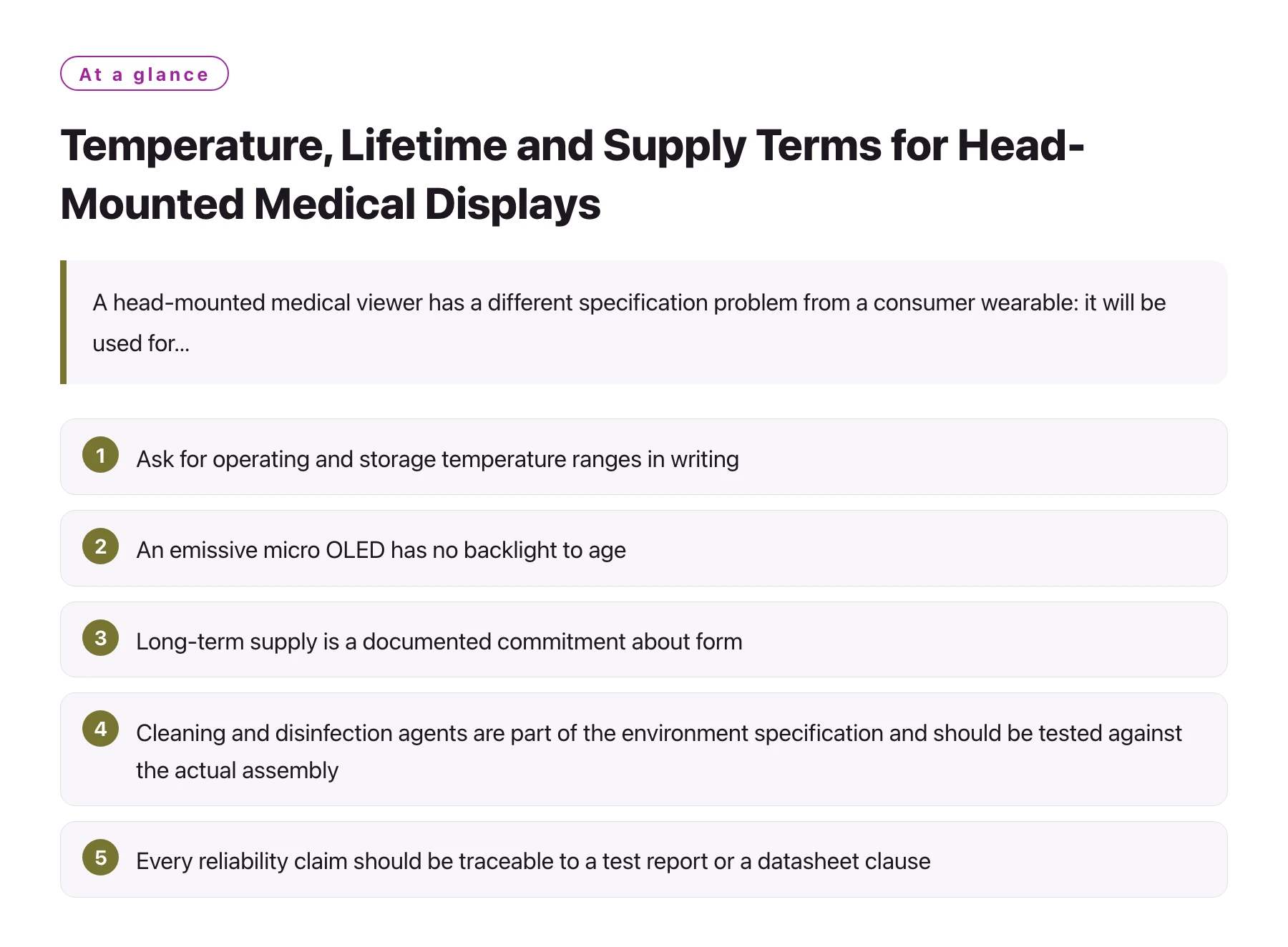
- Ask for operating and storage temperature ranges in writing, including the conditions under which each figure was measured.
- An emissive micro OLED has no backlight to age, so the wear question becomes differential ageing and image sticking rather than lamp hours.
- Long-term supply is a documented commitment about form, fit and function, not a verbal assurance that production will continue.
- Cleaning and disinfection agents are part of the environment specification and should be tested against the actual assembly, not the bare panel.
- Every reliability claim should be traceable to a test report or a datasheet clause, otherwise it should not appear in your risk file.
Clinical purchasing is driven by risk files and service plans, and display modules sit inside both. A viewer that drifts in brightness over two years creates a service burden. A module that is discontinued without a drop-in replacement forces a redesign of a device that may be in use for a decade.
The trap is that most of the relevant information is not in the headline specification. Operating temperature is often quoted as a single range without stating the conditions, lifetime is expressed in ways that do not map onto the actual use pattern, and supply continuity is discussed verbally until someone asks for it in a contract.
The three sections below turn those vague areas into questions with answers you can file. They are written for a 640x400 micro OLED used in a near-eye viewer, but the same structure applies to any display going into a regulated product.
Why medical viewers are specified differently
Consumer devices are replaced when they are superseded. Medical devices are maintained. That single difference changes which specifications carry weight: a slightly lower peak brightness is usually acceptable, while an undocumented temperature limit or an unclear second-source position is not.
The environment is also harsher in specific ways. A head-mounted viewer is worn, so it sees skin contact, sweat and repeated handling. It may be cleaned between patients, which exposes the assembly to solvents and wipes that were never part of the original mechanical design. And it may be stored in a cold room or a warm vehicle, then brought into use immediately.
The practical response is to write the environment down before choosing a module. Include the temperature range the device must survive in storage and in use, the list of cleaning agents, the expected number of operating hours and the expected service life. That document then drives every question you put to a display supplier, and it becomes the basis for your risk assessment. Published figures for a module such as www.displaymodule.com/products/0-23-inch-micro-oled-display are a starting point, but the questions in the next section are what turn a datasheet into a decision.
Questions to settle, and the evidence to accept
| Question | Why it matters in a clinical viewer | Evidence to request |
|---|---|---|
| What are the operating and storage temperature ranges? | Storage and use conditions differ, and a device may be brought into service straight from a cold store [1] | A datasheet clause that states both ranges and the conditions under which they were measured |
| How does the image change over thousands of hours? | An emissive display ages unevenly when some areas are driven harder than others [2] | A test report describing the pattern used, the drive level and how ageing was measured, not just a headline lifetime figure |
| What happens at the temperature extremes? | A viewer may be used immediately after storage, when the panel is not yet at room temperature | Behaviour at the cold and hot ends of the range, including start-up and any change in brightness or response time |
| Which cleaning agents are compatible? | Disinfection practice is part of the device's declared environment, not an operational detail | Compatibility data for the finished assembly, including any adhesive, coating or polariser that could be affected |
| What is the supply commitment over the service life? | A viewer in service for a decade cannot absorb a silent panel change | A written statement covering notification periods, change control and the form, fit and function terms of any replacement |
Two reliability questions people get wrong
The first is inherited from LCD practice and does not transfer. The second is treated as a procurement matter when it is really an engineering one.
There is no backlight to age
In a backlit LCD, brightness decay over the life of the product is largely a story about the light source. An emissive micro OLED has no such component, so asking for a lamp lifetime figure misses the point. The relevant questions concern the organic materials themselves: how the emission efficiency changes with accumulated drive, whether static interface elements leave a persistent trace, and how temperature accelerates both.
That is why the test conditions matter as much as the number. A lifetime figure measured with a full-screen white pattern at a fixed drive level describes a different stress from a real interface with a bright menu bar in the same position for hours at a time. Ask what pattern was used. If the answer is not available, plan your own accelerated test on the finished assembly [3].
There is a design response as well as a test response. Interface elements that never move are the most likely to leave a trace, so a user interface that shifts slightly, dims when idle or avoids permanently bright static regions reduces the stress the panel actually sees.
Supply continuity is a document, not a promise
Every display project eventually faces a module that is revised or retired. What determines whether that is a nuisance or a crisis is how much notice you receive and how tightly the replacement is defined. Ask for a notification period, a change-control process and a definition of form, fit and function that the supplier is willing to sign.
It is also worth asking who actually makes the panel and how many sources exist for it. A module assembled by one company from a panel made by another has two supply chains, and the weaker one sets the risk. Where a single source is unavoidable, the engineering mitigation is to keep the display interface abstracted in firmware and the mechanical mounting tolerant, so that a replacement panel has a chance of dropping in without a full redesign.
The most useful thing a display supplier can give a medical project is not a better number on the datasheet, it is a document that answers awkward questions precisely. Ask early, ask in writing, and treat an unanswered question as a risk to be managed rather than a detail to be resolved later. A viewer that has been designed around honest unknowns is far safer than one built on optimistic assumptions.
Sources
Frequently asked questions
What temperature information should be requested for a head-mounted viewer?
Ask for operating and storage ranges separately, with the conditions under which each was measured, and ask what changes at the extremes, including start-up behaviour after cold storage and any brightness or response-time shift at the hot end. A single range without conditions is not enough to write into a risk file.
Does an OLED module have a backlight lifetime specification?
No. An emissive display produces light in the pixel itself, so there is no separate light source. The equivalent questions concern how emission efficiency changes with accumulated drive, how uneven ageing appears, and how temperature accelerates those effects. Ask for the test pattern and drive conditions behind any lifetime claim.
How can supply continuity be secured for a long-life medical device?
Get it in writing: notification periods before a change or discontinuation, a change-control process, and an agreed definition of form, fit and function for any replacement. In parallel, keep the firmware interface and the mechanical mounting tolerant of a substitute panel, since documentation reduces the risk but does not eliminate it.
Should cleaning agents be part of the display specification?
Yes, if the device will be cleaned as part of normal use. Compatibility should be tested on the finished assembly rather than on a bare panel, because adhesives, coatings and surface treatments are often what a solvent attacks first. Put the agent list in the environment specification and test against it.